



















Welcome to the NEW Salesloft Community — Read all about it!
Share your hard word: learnings and wins
Recently active
Revenue leaders are faced with a hard truth. You're either developing an AI strategy, or you're signing up to get left behind. But with all the noise around AI development, it’s tough to decipher between high-impact business technology and shiny distractions. In the coming years, B2B revenue teams will invest millions in AI that doesn’t move the needle. In this letter, let’s shed light on 3 harmful AI myths and how you can combat them. Use this guide to refine your AI strategy and chart your path to a legendary revenue career. Myth 1: Revenue Teams Should Focus on Generative AIThe day ChatGPT launched, 99% of AI chatter shifted to Generative AI. Honestly, this isn’t surprising. Of all the types on the market, Generative AI is the easiest for revenue teams to see and experience, so it dominates the conversation. But an AI strategy focused exclusively on Generative AI misses the revenue-boosting potential of other AI types. Descriptive AI tells you what has happened in the past. It summa
For the last decade or so, CIOs have been on the sidelines, not in the driver’s seat, enabling other CXOs to run their businesses better. However, a new opportunity has emerged for CIOs to take a central role due to a significant issue: outdated systems for managing revenue. Many companies still rely on decades-old tools like Excel and CRM, leading to a massive problem called Revenue Leak, which costs the economy $2 trillion annually.This gap presents an opportunity for the modern CIO to oversee a unified system for managing revenue, integrating data, AI, workflows, and platforms. The “Revenue CIO” is essential for setting up and owning the entire revenue process, ultimately helping Chief Revenue Officers (CROs) capture more revenue.Our new guide (attached to this post) is designed to provide CIOs with a list of key topics they should discuss with the rest of the C-suite. It will assist you in breaking the ice with your CRO, leaning in, understanding the world of revenue, better captur
As a former "Navy F/A-18 pilot turned technology executive," Tanium's VP, Sales Operations & Strategy, Ben Stein, builds and leads "go-to-market teams that operate with the speed, precision, and camaraderie of a fighter squadron."Tanium is a cybersecurity and systems management company that provides a platform for IT operations and security. It offers real-time visibility and control of endpoints across large networks, enabling organizations to manage security threats, compliance, and system performance from a single console. We sat down (virtually, of course) with Ben to discuss how Clari helped him on "day 1" in his role as VP, Sales Operations & Strategy, how Clari helps his team maintain strong rigor around its forecasting motion, and more.How did Clari help you easily step into your role at Tanium?A: From Day 1, Clari has been my primary source of truth for pipeline and forecasting. My role requires me to understand our GTM performance holistically while also being able to
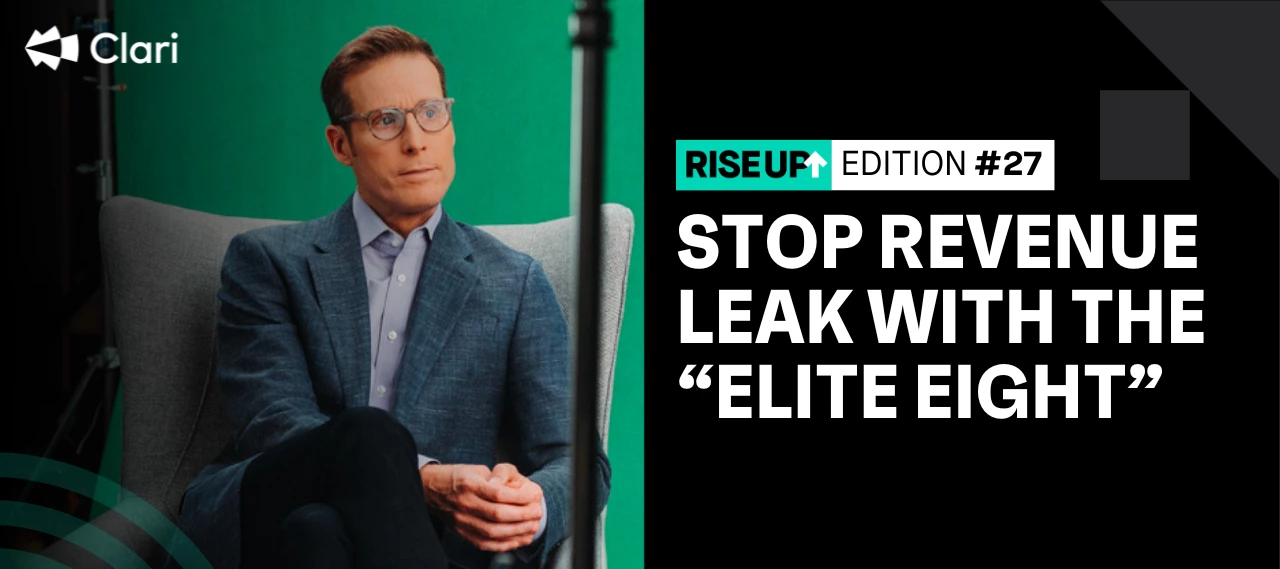
Picture this. You’re a CRO. It’s Monday morning and you’re in your CRM trying to figure out why your pipeline is down 12% from last night — but you can’t. That’s Revenue Leak. Or you’re a RevOps leader rolling out sales programs to drive pipeline. But you can’t figure out why it’s not translating into qualified sales opportunities. That’s Revenue Leak. Or you’re a frontline manager. You just found out that 40% of your committed deals slipped, and you don’t know why. That’s Revenue Leak. Revenue Leak is a $2 trillion market loss caused by breaks in the revenue process. This leak siphons opportunity from companies both big and small. At Clari, we deploy a framework called the “Elite Eight” to stop revenue leak today and keep it from returning tomorrow. With this framework, you can capture every drop of revenue at your company — and grow a legendary career in revenue. Let’s take a look. 1. Revenue ObjectivesRevenue Objectives are key strategic initiatives that dictate how the Revenue team
Clari gets to collaborate with world-class revenue organizations. See the most popular financial and operational objectives we see these teams set, and how they measure success in our Revenue Objectives Checklist:
Are you trying to reach new sales targets?Every marketing and sales manager has sales goals and KPIs to hit. But how do the best of the best reach those goals?With a simple solution: sales intelligence—often the missing piece to elevate your performance.By the end of 2024, the global sales intelligence market is expected to reach $3.4 billion.Why? More people are realizing just how impactful sales intelligence is on business growth.In this in-depth guide, we’ll explore sales intelligence, why it’s important, and how it can help drive sales and grow your business.Table of Contents: What is sales intelligence? What is sales artificial intelligence? Why is sales intelligence important? Sales intelligence key data points Where do you collect sales intelligence data from? How do you choose the right sales intelligence platform for your own business? What are some common sales intelligence platform features? How to use sales intelligence data in your own business Who should use sales intelli
This article was originally published in Forbes. It was written by Rohit Shrivastava, Clari’s EVP and Chief Product Officer, and who is responsible for the company's product strategy and roadmap.Sales is the most complicated—and mission-critical—business process. After all, what’s more important to a company’s long-term success than predictable, sustainable revenue growth?And yet revenue technology, or revtech, has yet to achieve top-tier priority status for most CIOs. As a result, the average enterprise revtech stack too often consists of a hodgepodge of siloed point solutions and backward-looking transactional systems that aren’t serving revenue professionals, or the business itself, particularly well. As the enterprise scales for growth, these point solutions inevitably hit a wall.This is all about to change—and none-too-soon—as a confluence of market pressures and technological innovations spur a complete rethinking of how technology should enable the end-to-end revenue process for
Every team runs revenue differently. Unique clients Unique team members Unique processesBut there are a handful of trendlines that cut across markets. Non-negotiables every team should adopt if they want to stop revenue leak and boost their bottom line. In a recent webinar, Kevin “KD” Dorsey (SVP at Bench Accounting) joined Clari’s Maya Connet (VP, Inside Sales) and Devin Reed (Head of Content) to spotlight 3 tech stack non-negotiables. Here’s what they shared:1. Integrate AI into the revenue processAI is reshaping the revenue landscape. Saving reps hours at every stage of the funnel Providing powerful analytics and insights Making forecasts more accurate than ever Cutting-edge teams are leaning into AI at every stage of their workflow. How? To start, they map the end-to-end revenue process, leaving no stone unturned. They look for areas of revenue leak, and identify key points where AI can automate or simplify. Next, they pull in AI experts. They recruit specialists onto the team —
You know you’re losing revenue. But you’re unsure if you need to improve your sales processes, concentrate on marketing, or manage customer churn.If you focus on driving sales, but the problem lies in customer success, you’ll waste your efforts.This is why knowing the difference between revenue operations (RevOps) and sales operations (SalesOps) is important.Understanding how the two differ helps you figure out which approach will help you capture more revenue to power growth.Let’s learn how these methodologies work, what sets them apart, and how you choose which approach works best for your team’s needs. Table of Contents:What are revenue operations? What are sales operations? 3 key differences between revenue operations vs. sales operations Revenue operations vs sales operations: Which function is best for your business? How do you combine both revenue operations and sales operations What's next?What are revenue operations?Revenue Operations, often called RevOps, acts like a strate
Companies don’t grow by accident. Every successful venture includes sharp strategy and an innovative product. They have dynamic marketing efforts, airtight operations, and savvy sales professionals. But more than anything, they have culture. How the company lives and breathes. Their shared values. What they tolerate and what they don’t. Culture is not free snacks, generous time off programs, and other superficial perks to make the company look good to outsiders. It’s about how people act every day. How do employees show respect for each other? Or support a frustrated customer? Or decide when a feature is “good enough” or still has room to be great? It’s the invisible stuff that makes a big difference. I’m proud of the culture we’ve built at Clari. As the company has grown — in 2022, we raised at a $2.6 billion valuation — culture has been the key ingredient to everything we’ve done. Without a strong culture, the entire org falls apart. Employee morale and retention drops. Trust vanishe
What’s your AI strategy? If you are a revenue leader right now, it is hard to avoid this question. But getting to a clear and actionable answer is not so straightforward.That’s why we’ve created 3 full playbooks to the process of identifying, organizing, and integrating AI solutions into your revenue workflow. To recap: Playbook 1: How to create an AI “habit loop” in your revenue processPlaybook 2: How to plug revenue leaks with cutting-edge techToday, we’re talking about a final key ingredient in making your AI strategy a success. The Human Element of AI AdoptionAs magical as some of these new AI technologies may seem, at this point they are anything but “plug and play” when it comes to transforming real business processes.Ideally, you’d identify the biggest source of revenue leak, point AI at it and watch your problems disappear. But there’s another factor you need to consider before pressing the “go” button. Trust.More than any other technology applied to the B2B revenue process in
One of my managers does not have their subordinates rolling up to them in the Forecast.In SDFC, they have a Profile = Manager. And I’ve placed their SFDC insides and our SFDC Roles below.What might be causing this? How do I fix this? Thanks!
Whether you’re a business owner, sales manager, or sales rep, you need to understand the steps in the sales process.If you skip or undervalue a step, it will directly affect how many deals you close. A prospect may stall and lose interest in your product or feel rushed and start to disengage.If you struggle to move leads through the customer journey, mastering each sales process step will help.In this article, we’ll explore each sales process step in detail, offer best practices, and share how you can create a unique sales process for your business. Table of Content: What is the sales process? Why does the sales process matter? The 7 steps of the sales process The sales process is unique to each business What’s next? What is the sales process? A sales process is a series of steps you develop to help your sales reps find and engage prospects and gradually turn them into customers. A typical sales process includes prospecting, preparation, approach, presentation, handling objections, and
Q4 is back! I recorded a short video on Trend to show you how to look at where you finished this time last year, see if you have built more pipeline and how robust it is, and if your conversion rates stage over stage have improved compared to last year.
4 trillion.As we announced last week, that’s the amount of closed-won revenue flowing through the Clari Revenue Platform.We’re the first company to surpass $4T of revenue under management, making us the Revenue Platform Category Leader. $4 TRILLION (with a T). For perspective, that’s the approximate market cap of Alphabet (Google) + Amazon. It’s more than the UK’s GDP.And thanks to our amazing customers, we know more about running revenue than any company on earth.Why? We’re constantly collecting terabytes and terabytes of revenue data and analyzing how companies manage their enterprise revenue process.All day. Every day.As the first RevTech company to cross $4T of revenue under management...We have the largest revenue database in the world, which fuels our best-in-class Rev AI. We have the widest and deepest product functionality on the market. We have the most expertise for running revenue of any player in the space. We have the largest footprint of massive multi-billion publicly tra
Looking to fully optimize the Clari platform but don’t know where to start? Chances are you’re already a third of the way there!I like to look at the full optimization of Clari as a triangle. At the base we have opportunity management and forecasting via Inspect and Forecast. More often than not, your teams are already heavily engaged with this area of the product - likely submitting weekly forecast numbers and updating each opportunity line item as deals progress.Analyze is where teams start to feel overwhelmed. I consistently hear “I don’t know where to start!” or “I feel like I have a Ferrari and I’m driving it like a Ford!” (no offense to any fellow Ford drivers out there...)Utilizing our robust analytics capabilities doesn’t have to feel overwhelming! Are you a Sales Rep? Start by using Flow to gain insight into Idle pipeline. Are you a Manager? Open up Funnel to gain insight into whether specific Reps have a pattern of losing deals at a certain point in the sales cycle. Are you a
How do you stay on top of a full pipeline, discover how to improve your sales process, and continue to deliver personalized outreach to every one of your prospects?You can’t on your own. But you can with conversational AI. This isn’t just a tool that creates automated chatbots to take the load off your customer service team. You can also use conversational AI to give sales reps and managers everything they need to spot revenue leaks and close deals faster. In this article, we’ll show you how. Table of Contents: What is conversational AI? How does conversational AI work? What are the benefits of conversational AI? Real-world examples of how to use conversational AI What are the challenges of conversational AI, and how do you overcome them? 4 best practices for using conversational AI The future of conversational AI Try the only revenue-focused conversational intelligence solutionWhat is conversational AI?Conversational artificial intelligence is a technology capable of understanding an
These days, I spend a lot of time talking with customers about AI. They are facing imperatives to improve efficiency, and the potential is clear.Our data on the value of applying AI to running revenue backs up the hype:90% reduction in forecasting time for RevOps 67% increase in productivity across revenue-critical employees 10%increase in win rates But driving AI adoption is a new muscle for nearly every organization. Many companies are paralyzed by the seemingly simple question: Where do I start? MY RECOMMENDATIONSet aside new and unfamiliar technology and start with what you know - your process.Mapping your revenue processA solid AI strategy starts with a good understanding of your revenue process and the business outcomes you are trying to drive. At the risk of oversimplifying, you can break your revenue process down into three stages as a good starting point:Create In this stage, your team generates leads and moves them into the pipeline. The create stage is all about capturing
When thinking about last quarter or last month, was there a drop off in the pipeline at a certain stage? Are you left scratching around for reports or trying to understand why deals are dropping off after the discovery stage or why conversions at a certain stage are dropping? In the short video I recorded, I’ll walk you through how you can inspect your pipeline conversion stage over stage using Funnel. You can review the that dropped from each stage to understand where there are areas for improvement.
Success in sales is a matter of quality and quantity. Personalized outreach is essential if you want to stand out from the dozens of other cold messages your prospects receive every day. But you know that most prospects won’t need your product right now. That’s why you need to reach out to hundreds of prospects each week. But you simply can’t personalize messages at that scale.That’s where sales engagement automation platforms come in. In this article, we’ll show you how these tools can accelerate the sales engagement process and help you send hundreds of high-quality emails at once. We even review the ten best sales engagement automation platforms. Table of Contents: What is sales engagement automation? What are the benefits of sales engagement automation? The 10 best sales engagement automation platforms How do you know which sales engagement automation platform is right for you? What's next?What is sales engagement automation?Sales engagement fosters a meaningful connection with pot
New sales technologies mean new opportunities to help your sales team perform at their best. Sales enablement and sales engagement can help lay the foundation for high-performing reps.Many think these terms are interchangeable. However, different approaches optimize different aspects of the sales process.This guide will explain the similarities and differences between sales enablement vs. sales engagement. You’ll explore examples, strategies, recommended tools, and more.Table of content:What is sales enablement? What is sales engagement? What are the similarities between sales enablement and sales engagement? What are the differences between sales enablement and sales engagement? How do sales enablement and sales engagement work together? Why have both sales enablement and sales engagement strategies? How to effectively implement sales enablement and sales engagement strategies Sales enablement tools vs. sales engagement platforms How to know which tools are right for your business Wh
The best chief revenue officers know how to build a strong culture, hire well, and focus on simplicity in a sea of complexity as they lead their revenue operations teams. With over 500 CROs leveraging Clari, there's no shortage of top leaders to learn from. Here’s some of the top tips I’ve learned from CROs. Hire strong overseas"The further away the hire is from you physically, the stronger they need to be."Relativity Chief Sales Officer Peter KimNew market expansion is a top priority for revenue leaders, and it starts with hiring. According to a study Clari commissioned with Forrester, 51% of revenue leaders say expanding into new geographies or vertical markets is a top priority. Penetrating new markets can propel a company to new heights, so getting it right is mission critical. It all starts with hiring right.Knowledge is power — leverage all available resources“Encourage your reps to follow people’s Twitter feed. It gives you some insights into what they think about.Bloomreach CR
Unless you've been hiding under a rock the past five years, you are very familiar with the rise of consumption revenue models if you're in SaaS or any related business. Simply put, in a consumption or usage-based model, you don't pay an up-front cost for unlimited use of a product or service. You pay only for what you use.You can think of a consumption model as analogous to a utility, like electricity. The utility is connected to a meter, through which usage levels can be measured and billed. The rise of cloud-based applications has made this kind of usage metering possible for software, giving way to a rise in consumption-based business models.Why use a consumption model?Customers often love consumption models because they only have to pay for what they use, and they can ramp their spend up and down according to their needs. This is especially beneficial for companies that leverage third party cloud solutions as part of their own products that they deliver to customers—they don't wan
Clari hit a massive milestone this month. Clari passed $4 trillion in revenue under management. That’s how much revenue is flowing through the Clari Revenue Platform. As a point of reference, that’s more than the market cap of Google and Amazon combined. Thanks to our customers, we know more about how to run revenue than any company on earth. And with every dollar, we gain a clearer picture of the market and where revenue teams are running into roadblocks. Today, I’d like to use this eye-opening data to discuss revenue in the Age of AI.Here are 3 lessons every revenue leader can use to position themselves for future success. Let’s take a look. 1. You’re not missing targets because of low pipeline coverage Attainment is low because of revenue leaks. These breakdowns in your revenue process drain dollars every single day. And until you plug them, metrics like pipeline coverage won’t solve underlying issues. On average, you’re losing 14.9% of your annual revenue because of revenue leak. W
THE AI “HABIT LOOP”From the moment we all had our first magical interaction with ChatGPT, the past year has been dominated by curiosity about generative AI. My first ChatGPT moment was laughing with my wife about the creative excuses it generated for why we couldn’t perform our household chores…. On a more serious note, I’ve observed revenue teams getting deeply curious about ChatGPT’s impact on the most important business process in the enterprise.Which tasks is AI best suited to streamline and automate? How is it going to impact my work on a daily basis? How will this change roles and companies?But so far, there have been more questions than answers. This phase is common for new technologies – it takes time to digest the potential impact of a new technology and incorporate it into our lives. Now, the curiosity window is quickly closing — especially for companies that want to be at the cutting-edge of AI. In 2024, the name of the game is habitual use and value: shifting from GenAI as
Already have an account? Login
No account yet? Create an account
Enter your E-mail address. We'll send you an e-mail with instructions to reset your password.