


















Welcome to the NEW Salesloft Community — Read all about it!
Share your hard word: learnings and wins
Recently active
For most sales teams, Q1 has just finished and it’s time to reflect. It’s QBR week. Sales and leadership teams all over are reflecting on their performance at the start of the year, reviewing closed won deals, pipeline generated, what worked and what didn’t. I recorded a 2-minute video on how many customers, and myself, answer all of these questions and more with Dashboards.
Did you know that we listen at 125-250 words per minute, but think at 1000-3000 words per minute? When we are on a discovery call or a demo and the customer is dropping golden nuggets of information, we hear and process it much slower than the reply that is already being formulated in our brain. We miss stuff.CI tools are rife these days and most of the capabilities are table stakes. For Clari Copilot customers, there are 3 main differences: Being able to bookmark important moments in a call to go back to, making sure we are intently listening to the customer. Having calls in Clari, meeting them where they work and being able to inspect the insights from conversations against revenue data. *Whispers* - it’s better value for money. I’ll walk you through it in this short video that I recorded.
Ah Q3—The penultimate quarter before the big one to finish the year, and it’s starting to heat up, just like the weather (us Brits love to reference the weather). You’re across all the deals, driving pipeline rigour and helping the team close business, no doubt. What about the accounts themselves though? How do you know where your reps are spending their time and is it in the right places? At the halfway point, are there any customers or prospects that you could spend more time with to drive more top of funnel? I recorded this 3-minute video to walk you through Account Engagement in Clari and how it helps sales teams prioritize accounts and see where they should spending their time.
What do growing businesses need? Enough capital to ensure consistent growth. There are two ways to do this: You either bootstrap or seek venture capital (VC) funding.But how do you determine which option will work best for your business? If there’s someone who knows how to answer this question with confidence, it’s Justin Borgman, chairman and CEO of Starburst.Justin founded his first company, Hadapt, in 2010, which was acquired by Teradata in 2014. After a stint at Teradata as VP and GM, Center for Hadoop, he founded Starburst. He chose to bootstrap the company but switched funding lanes later.We recently had the pleasure of hosting Justin on our Run Revenue Show, where he shared his nuggets of wisdom on the bootstrap vs. VC funding conundrum.Bootstrap or get VC funding: Pros and consBootstrapping gives you a lot more room to be experimentalThe initial stages of building a product and finding the right market fit take a lot of iterating. As amazing as it would be, nobody gets these ri
RevOps leaders! We have all been there. We set up the meetings and provide a focused agenda as a template for all revenue roles to run 1:1s, weekly forecast meetings, and of course, Quarterly Business Review/Planning calls, (QBR/QBP) to review or prepare for the next quarter. Then something inevitably happens; a new leader comes in, you miss a quarterly number, or a change in your GTM strategy occurs, and disrupts the agendas and rigor of your revenue cadence. One of my favorite quotes is the famous Mike Tyson one, (which has different variations, but rings so true!): “Everyone has a plan until they get punched in the mouth.”When ‘combat’ begins, meeting agendas change, topics are re-arranged, and it is very easy to lose focus and standardization in your process as the business works to quickly adapt. At this stage, it is even more important to double down on your revenue cadence and assure that all bases are covered. The best organizations I have seen running revenue have their cadenc
What gets measured gets improved. This saying — popularized by legendary consultant Peter Drucker — made sense in an era when measuring business performance was costly and difficult. But now, we’re living in the age of data and AI. Measurement is great – but it needs to be strategic and efficient. If not, your teams will run headfirst into a wall of tech fatigue.Too many systems. So much messy data.It’s overwhelming. To tackle the challenge of tech fatigue, two 2024 RevOps Award Winners, David Hayward (Senior VP GTM, Yext) and Deborah Fritz (VP, Global Field Ops, LiveRamp), sat down with Devin Reed (Head of Content, Clari) for a recent webinar. Here’s what they talked about. More tools, lower adoptionToday, it’s common for revenue teams to juggle an average of 7-10 tools. And every tool introduces: Data inconsistencies Navigation challenges Additional costsHow did we get here? As Deborah notes, revenue tech stacks build up over time.“As we've grown, we've definitely experienced people
Revenue growth doesn’t happen by accident. It’s a process you need to build, execute, and optimize. Enter revenue optimization.Revenue optimization encourages businesses to take a holistic approach to revenue. One that doesn’t just rely on a single source of growth like new customer acquisition but that brings together sales, marketing, and customer success to build a sustainable and resilient revenue pipeline.This article explains revenue optimization, why it’s so important, and five strategies you can use to optimize your revenue today. Table of content: What is revenue optimization? Why revenue optimization matters 5 revenue optimization strategies to implement today How a revenue platform can optimize revenue ConclusionWhat is revenue optimization?Revenue optimization is the management of acquisition, retention, and expansion strategies to improve profits. Typically, businesses only focus on one or two of the following ways to generate revenue:Acquisition: bringing in net new custo
Revenue leak happens every minute of every day. Companies struggle to capture revenue they've worked hard to earn. Opportunities vanish, deals fall through, and business walks out the door. At Clari, we get a 360-degree view of revenue leak. With over $4 trillion under management, our revenue database is packed with data points that tell a story of missed opportunities and growth barriers. Clari Labs found the average annual leak is 14.9% of total revenue. How do you stop leaks and run revenue more efficiently? Today, let's look at 3 ways your company can identify and plug revenue leaks. Plus, see how a major healthcare life sciences company used this playbook to capture more revenue. Let’s get into it. 1. Conduct a revenue leak assessmentTo stop revenue leak, you have to identify where it’s coming from. When Clari walks into a new company, we kick off with a thorough revenue leak assessment. An end-to-end look at the revenue process and where there are gaps. With this assessment, we s
When planning future sales or marketing efforts, you need reliable estimates of your sales numbers.Revenue projections and revenue forecasts are two different approaches that can help you achieve this. However, their methods and applications are quite different. How do you know which one is right for you?That’s what we’re going to explore in this comparison article. We break down exactly what revenue projections and forecasts are, highlight key differences, and cover the best forecasting methods for go-to-market teams in 2024.Table of contents:What are revenue projections? What are revenue forecasts? 3 key differences between revenue projections vs. forecasts When should you use revenue projections vs. revenue forecasts? Get more accurate revenue projections and forecasts with AI and broader data Use other smart tools like deal scoring to help your reps close more dealsWhat are revenue projections?Revenue projections are a company’s estimated earnings for a given period. They’re often
In 2024, B2B sales pros understand the power of buyer collaboration:Reduced risk Fewer mistakes Faster conversionAnd, ultimately, more deals in the “closed-won” column. To break down buyer collaboration, Clari’s Tom Williams (Head of Clari Align) and Devin Reed (Head of Content) sat down for a chat with award-winning sales leader, Kevin “KD” Dorsey on a recent webinar.Here are the four key stages of buyer collaboration they discussed. Stage 1: ProblemEvery sale starts with a problem. Common ones include: Costs are too high Customers aren’t happy Processes aren’t workingWhichever problem your prospect has is the centerpoint of your sales opening. But too many reps rely on their interpretation of the problem. Not a mutual understanding. If you aren’t 20/20 on the problem statement, you and the buyer will start moving in different directions. This will scuttle your sale. Do this:Write down your understanding of the buyer's problem and get them to validate that you have captured it correct
“Even the most successful businesses need to hit ‘pause’ sometimes. Coming up for oxygen allows for clear thinking, fresh perspectives, and renewed energy."Simon Sinek, motivational speaker and author Arm Limited (“Arm”), a semiconductor and software design company, needed some “fresh air” in its revenue process. Jack Thompson, Senior Director of Sales Operations, described the pre-Clari pipeline and forecasting process as follows: “Lots (and lots) of time spent on analysis. We’d extract data from Salesforce.com and do some analysis — what's changed week over week, where things are pushed or pulled in, and so on.” The issue was not the amount of data Arm had at its disposal. It was the time it took to gather all that data from disparate sources, compile it, present it, and review it. “When we noticed changes, we’d have to schedule a meeting to discuss them — a real waste of everybody's time and efficiency.”Before Clari, “it’s like we were running an organization from Salesforce downloa
Spring is here. The nights are longer, the sun is starting to beam through, and the air is crisp. It’s time to review your AI Projection in Pulse to see where Clari thinks you’re going to finish Q2. Let’s see if you can beat the machine! I recorded a quick video to walk you through a simple breakdown of Clari’s Pulse Module. Powered by AI, Pulse looks at historical data and current pipeline in each stage to predict where it thinks you’ll finish the year.
Originally written by Julien Sauvage and published in Sales Tech Series Like many, I have a love/hate relationship with AI. And I love Generative AI (GenAI) for different reasons than many.The main reason? GenAI has been driving high demand for RevTech, in some cases for the first time. More non-tech verticals like financial services and healthcare will adopt the technology as GenAI sparks more curiosity about RevTech, its use cases, potential, and obstacles. As the risk of tech commoditization becomes more real, GenAI has also been putting more pressure on vendors to deliver high-quality products.What I hate about AI? It has created so much confusion and just a whole lot of noise. Vendors making silly claims, buyers having unrealistic expectations.This is why I wanted to take a shot at busting a few myths when it comes to “AI for Revenue” while expressing my POV in a more pragmatic way. Let’s go.Myth 1: Generative AI Is Mostly About the Top of the FunnelOur perception of GenAI comes,
Not all bounced emails are the same. It’s important to understand what types of bounces are occurring within your organization so you can tackle accordingly. Did you know that Groove can write bounce reasons back into salesforce? Check out the help center article - Writing bounce codes into salesforce
Sales engagement has changed the way teams go to market. It’s allowed them to be more efficient, more targeted, and more creative in the way they generate business. Heck, this post is even part of a multi-touch, 12-month Flow that I created in Groove to share use cases and insights into how you as a sales leader can get more out of Clari. I created the content, recorded the videos, loaded it into Groove, and hit SEND. Check out this short video that @Ketan Mistry recorded to learn about why being Groovy is the best way to be.
Forecasting is an art and a science. Clari can be your guiding light when entering in your prediction for success. There's a number of ways the platform can help drive predictability and precision in the roll up. In this short video, I’ll take you through how to put your forecast together, inspecting the rollup to pressure test if the number is too conservative, or more bullish than it should be.
I led Clari’s first board meeting in 2013. Since then, we’ve grown from the garage to a multi-billion-dollar enterprise. And board meetings have been an essential part of the journey. When run correctly, board meetings can:Unlock new business insights Solve critical problems Unify your entire orgSadly, too many board meetings miss the mark. They’re flat, operational read-outs that waste valuable resources and keep the high-powered board on the sidelines. That’s why I put together The Executive’s Guide to Board Meetings, a comprehensive document that helps senior leaders prepare for, deliver, and follow up efficiently for all board meetings. Today, I’d like to focus on the “why” behind board meetings. The mindset that’s helped me turn Clari board meetings into our most valuable session every quarter. Then, if you’d like to see the “how,” including a step-by-step process, you can download your copy of The Executive’s Guide to Board Meetings here. Let’s get started. 1. Set your meeting up
Podcast with Kevin Knieriem, Clari President: Listen in hereLearn how revenue platforms like Clari, Gong, and Outreach have evolved over the years and how Clari’s President, Kevin Knieriem, is expanding their SAM into verticals like medical devices, manufacturing, and financial services. The group also discusses Clari’s approach to becoming a unified revenue platform.Want more Topline? Read the recaps and join the Topline Slack channel to engage with the hosts and other listeners. Listen in here
Becoming a revenue leaderAs a revenue leader, you oversee and integrate sales, marketing, and customer success operations — the three main revenue-generating teams.Your goals? Streamlining processes. Optimizing revenue generation. Your challenges? Empowering your team to take charge and see the bigger picture, the organization’s larger goals. Balancing priorities. Fostering collaboration.Anil Kumar, Principal of the Strategic Resource Group at Thomas H. Lee Partners (and previous Head of Revenue Operations at Asana), joined us on The Run Revenue Show to share how he’s worked to accomplish these goals and address the many challenges a revenue leader faces. Let’s start by defining what a RevOps leader does.What does the Head of RevOps do (and not do)?Head of Revenue Operations (RevOps) is the fastest-growing job in America according to LinkedIn's 2023 "Jobs on the Rise" list.Here is how RevOps is often portrayed, to those not in a RevOps leadership role: MarketingOps + SalesOps + Custom
The job of a CEO is to lead the board, not manage it.In our board meetings, my goal isn’t to seek approval or avoid criticism. Instead, I call out operational shortcomings, share our plans for improvement, and get the board to pressure test our thinking on proposed solutions.Our goal is to maximize the brainpower of our board in a manner that gives us a competitive advantage. It wasn’t always like this. It took years of refinement.To help you do the same, I put all my learnings together and published The Executive’s Guide to Successful Board Meetings to show execs how to get the most out of their board. See attached.The guide covers: - Your exact role in the meeting (and common mistakes to avoid)- A framework for prep, delivery and effective follow up- Why the meetings between the meetings matter (and how to make the most of them)What’s inside this new reportIf you’re leading or contributing to board meetings, I believe this will help you realize your board’s full potential – leading
Book more qualified meetingsThere’s a dream partnership inside every sales org. One player crushes prospecting. The other closes business in their sleep. Pair these two and you have the makings of a winning team. More opportunities Higher quality meetings Bottom-line growthThese potential partners are the SDR and AE.But they rarely team up. Sadly, too many sales pros let a lack of incentives, leadership direction, and knowledge get in the way of this growth strategy. Big miss. We pulled together a sales dream team for a recent webinar. Morgan J Ingram, CEO at Amp, joined Clari’s Devin Reed and Kyle Coleman to break down co-prospecting. Here’s what they shared. The WhatCo-prospecting is a strategic partnership. To get in front of more high-quality leads and refine the pipeline, the SDR and AE should collaborate from the start of the sales process. With co-prospecting, SDRs and AEs should: Develop account plans by researching target accounts and building a point of view on priorities, pa
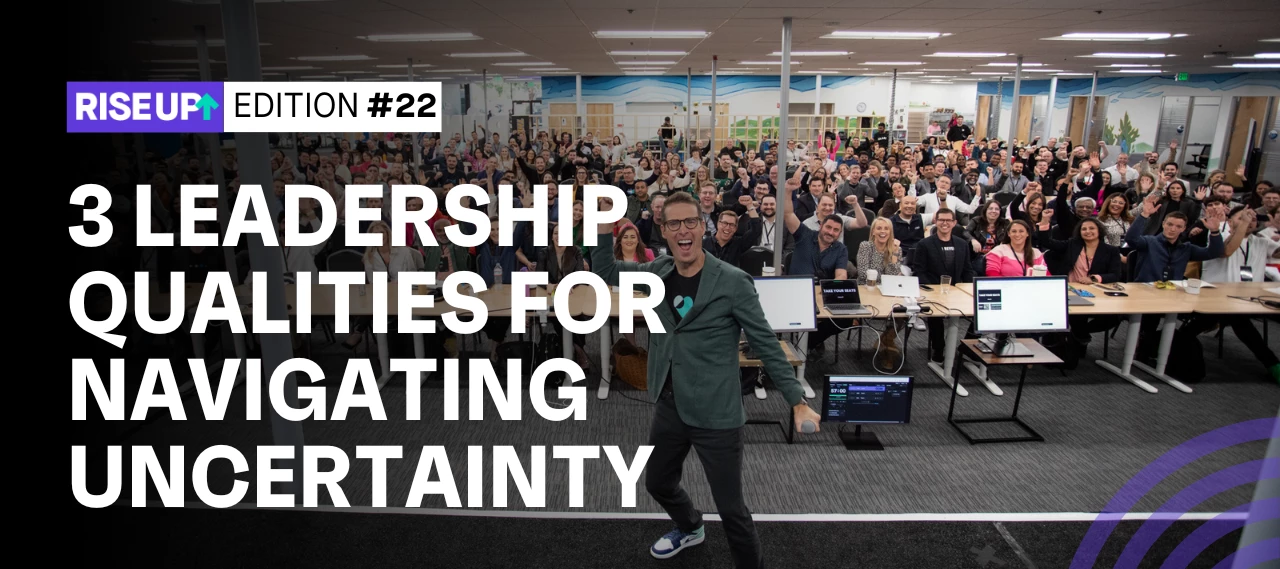
In 2021, I sat down with Zoom CEO, Eric Yuan.Our conversation focused on a critical topic — leading through uncertain times. The world was struggling through a pandemic, and the question on every leader’s mind was, “How do we help our teams through this crisis?”From that conversation, 3 key qualities emerged. Empathy, adaptability, and transparency.I believe these qualities are just as relevant today as they were in 2021. So, let’s look at how, as a revenue leader, you can help your team through tough times by embracing empathy, adaptability, and transparency. #1 - EmpathyGone are the days of business-only conversation.A decade ago, many leaders could get away with structuring their 1:1s exclusively around work. Talk through project updates and barriers, provide feedback, and call it a day.This approach overlooked the human side of the company. And it simply isn’t an effective model of leadership, especially during tough times.Today, empathy is a key ingredient.Empathy allows you, as a
Filling the sales pipeline.Forecasting with accuracy and precision.These, arguably, are two of the most essential factors impacting revenue acceleration. And one that requires a delicate balancing act — having (more than) enough opportunities while accurately (and consistently) guessing what might happen next.We chatted with Jeremey Donovan, former semiconductor engineer turned EVP of Revenue Operations and Strategy at Insight. Jeremey comes to RevOps with an engineering mindset about how to solve problems and approach questions and processes with data and statistics. He’s “always geeking out — a learning machine who loves to read, to consume podcasts ... everything.”Our conversation with Jeremey on the Run Revenue Show explained several ways to “walk the tightrope.” The Insight team conducted a survey across its entire portfolio that yielded some fascinating findings.Specifically, the data from the Insight survey suggest the following three keys to maximize pipeline and forecast accur
Revenue Governance Governance…. Yes, I admit, excitement probably wasn’t the emotion you felt after reading that word. If you’re in SaaS, you probably want to stop reading right now, but I’m challenging you: Give one more minute of your time and then make the decision to continue reading or move on. Do any of these phrases resonate with you?I want to make data-driven decisions. I want my team to interact seamlessly with downstream and upstream orgs. I am growing this company to IPO. If you answered yes to any of those, it’s time to take your vitamins and learn about what governance means in a modern SaaS context. If you continue to ignore the concept, it will come back to haunt you at the most critical time (think right before that S-1 filing, when the auditors start really digging). Governance in the context of RevOps, one word - TRUSTUltimately, why focus on governance at all? The end goal of governance is trust. If I’m looking at this report or analysis, can I actually trust it? A
Every leader I know is thinking about AI.We’re living through a transformative time in business. And AI adoption could be the difference between surging ahead of competitors or fading into obscurity.That’s why strategy is so important. AI may be the most powerful tool your company can use to transform your revenue process. But it’s accompanied by legitimate concerns and technical hurdles. Balance is key.How are you thinking about AI strategy?Here are three guiding principles to help you tackle tough AI questions and build a legendary career in revenue. Principle #1 - Companies will win with proprietary data and workflow integrationThe base AI model is now a commodity.With the widespread availability of AI, simple adoption is no longer enough. Every one of your competitors has access to base models — and sooner or later they’ll figure out how to maximize their use.So, how do you win in the market?Teams who want to reinvent the revenue process and deliver breakthrough results need to foc
Already have an account? Login
No account yet? Create an account
Enter your E-mail address. We'll send you an e-mail with instructions to reset your password.